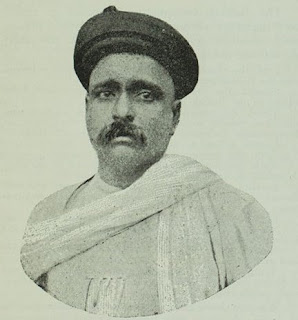
India Celebrates Bal Gangadhar Tilak’s Birthday

                                             Bal Gangadhar Tilak / Image credit

Today India is celebrating the 165th birth anniversary of Bal Gangadhar Tilak, a leading light of Indian freedom struggle. 

Of Bal Gangadhar Tilak, Edwin Samuel Montagu, British Secretary of State for India between 1917 and 1922, said, "Tilak is at the moment probably the most powerful man in India".

One of the famous triumvirate called “Lal-Bal-Pal”, Bal Gangadhar Tilak was born on July 23, 1856 in Ratnagiri district in the Konkan region of Maharashtra. 

Bal Gangadhar Tilak was educated in Poona where had co-founded Fergusson College, a landmark educational institution in Maharashtra. A scholar in mathematics, law and Sanskrit, Tilak was one of the founders of the Deccan Education Society in 1884, with Gopal Ganesh Agarkar,  Madhavrao Namjoshi  and  Vishnushastri Chipalunkar  being the other members. 

During Home Rule movement which he started in 1914 Bal Gangadhar was given the epithet of Lokamanya (Universally Respected). Tilak was called "father of Indian unrest" by Sir Ignatius Valentine Chirol, a British journalist. 

Tilak was imprisoned several times by the British authorities on charges of sedition. In July 1908, he was imprisoned for six years on charges of sedition and sent to Mandalay Jail in present-day Myanmar where he wrote Gita Rahasya or Bhagavad Gita . The Arctic Home in the Vedas was also written by Tilak. 

The nationalist poet Subramania Bharati translated Tilak’s Tenets of the New Party into Tamil. 

Tilak had launched two newspapers, Kesari (in Marathi) and Mahratta (in English). His trenchant criticism of colonial rule through these newspapers earned him the ire of the British administration.

Tilak initiated two important festivals, Ganesh in 1893 and Shivaji in 1895.

In 1916 Tilak signed the historic Lucknow Pact also known as the Congress–League Pact. 

Tilak breathed his last in Bombay on August 1, 1920. Gandhi wrote of him in Young India on August 4, 1920: 

“A giant among men has fallen. The voice of the lion is hushed… He knew no religion but love of his country. He was a born democrat. He believed in the rule of majority with an intensity that fairly frightened me…No man preached the gospel of swaraj with the consistency and the insistence of Lokamanya.” 


Famous Quotes from Bal Gangadhar Tilak 

"Swaraj is my birthright, and I shall have it!"

'If God were to tolerate untouchability, I would not recognise Him as God at all.'' 


Comments

Popular posts from this blog

Matangini Hazra

Matangini Hazra was a woman revolutionary and brave freedom fighter who fought for the independence of India from the British and laid down her life for it.  She was from a small village called Hogla located near Tamluk, the headquarters of the Purba Medinipur district in West Bengal. Hazra was born on October 19, 1870. Matangini Hazra was one of the protagonists of the Tamralipta Jatiya Sarkar (Tamralipta National Government), a parallel government established during the Quit India Movement.  Matangini Hazra was shot dead by the police in front of the Tamluk Police Station on 29 September 1942.  Matangini Hazra was  affectionately known as Gandhi buri, Bengali for old lady Gandhi.  The famed Hazra Road in Kolkata is also named after her. 

Muhammad Shah Rangila

Aurangzeb, the last great Mughal emperor, died in 1707. Muhammad Shah became Mughal emperor in 1719. During the interregnum, Bahadur Shah I , Jahandar Shah, Farrukhsiyar, Rafi-ud-Darajat and Rafi-ud-Daula ascended the Mughal throne. Jahandar Shah was murdered on the orders of Farrukhsiyar who had the support of the two powerful Mughal nobles Sayyid Abdullah and his brother Sayyid Husain Ali at that time. They are famous in history as Sayyid brothers, the King-makers. In 1719, Farrukhsiyar were murdered in utter disregard of a Mughal emperor by Sayyid brothers. Rafi-ud-Darajat died of consumption in a few months. Rafi-ud-Daula was addicted to opium and died in 4 months. Sayyid brothers now chose Raushan Akhtar, a son of Jahan Shah (the fourth son of Bahadur Shah I), to be the emperor. Raushan Akhtar ascended the throne under the title of Muhamamd Shah in September 1719. In the beginning Muhammad Shah was a puppet in the hands of Sayyid brothers who soon began to lose their gri...

Minhaj-us-Siraj: Author of Tabaqat-i-Nasiri

Minhaj-ud-din Abu Uraar bin Siraj-ud-din al-Juzjani, popularly known as Minhaj-us-Siraj,  was a medieval historian who was patronized by Slave Sultan Nasir-ud-din Mahmud to whom he had dedicated his magnum opus Tabaqat-i-Nasiri . Since Siraj held the high office of the Chief Qazi of Delhi to which he was appointed by Nasir-ud-din Mahmud, it is natural that Tabaqat-i-Nasiri gives a first hand account of the historical events from the conquest of Delhi by Muhammad of Ghur up to the year 1260 AD. Siraj was temporarily removed from the post of Chief Qazi from 1253 to 1255 when a section of nobles induced the Sultan to send his prime minister Balban into exile.  Tabaqat-i-Nasiri has been translated into English by Raverty .   -------------------------------------------------------------------------------------------------------------------------------- This page was last edited on 24 July 2021