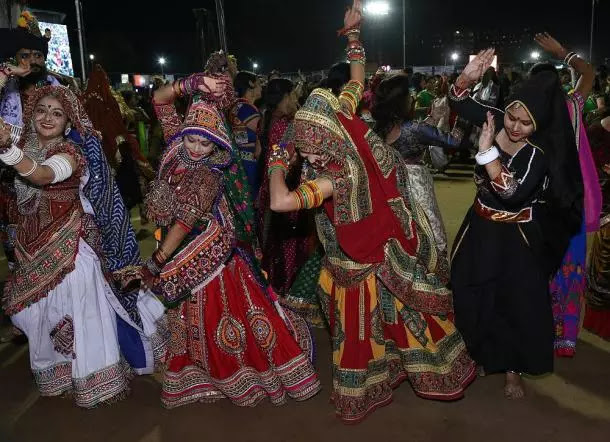
Gujarat’s Garba dance Gets UNESCO heritage status


United Nations Educational, Scientific and Cultural Organization (UNESCO ) has added Gujarat's traditional Garba dance to its 'Representative List of Intangible Cultural Heritage of Humanity.'

The inclusion of Garba now makes it India’s 15th inscription on the List.

India had nominated Garba for inclusion in the list. Garba is performed across Gujarat and in many other parts of the country for nine days during the festival of Navaratri . The festival is dedicated to the worship of the feminine energy or Shakti. 

The inclusion was made under the 2003 Convention for the Safeguarding of Intangible Cultural Heritage during the 18th meeting of the Intergovernmental Committee for the Safeguarding of the Intangible Cultural Heritage on Tuesday. The meeting is taking place began in Kasane, Botswana from 5 to 9 December 2023.

Apart from ‘Garba of Gujarat,’ some of the new inscriptions include Rickshaws and Rickshaw painting in Dhaka from Bangladesh, Songkran in Thailand, traditional Thai New Year festival from Thailand, Hiragasy, a performing art of the Central Highlands of Madagascar, Junkanoo from the Bahamas, and the Procession and celebrations of Prophet Mohammed's birthday in Sudan, among others. 

India now has 15 intangible cultural heritage elements on the UNESCO list. UNESCO has added Kolkata's Durga Puja to its 'Representative List of Intangible Cultural Heritage of Humanity. in 2021.  Other Indian entries that were previously inscribed include Ramlila (2008), Yoga (2016) and Kumbh Mela (2017).

In 2017, the Kumbh Mela was accorded this recognition. Yoga was added to the UNESCO Intangible Cultural Heritage list in 2016, traditional brass and copper craft of Punjab in 2014, Manipur's Sankirtana ritual singing in 2013 and the dance forms of Chhau, Kalbelia and Mudiyettu in 2010.


Comments

Popular posts from this blog

Matangini Hazra

Matangini Hazra was a woman revolutionary and brave freedom fighter who fought for the independence of India from the British and laid down her life for it.  She was from a small village called Hogla located near Tamluk, the headquarters of the Purba Medinipur district in West Bengal. Hazra was born on October 19, 1870. Matangini Hazra was one of the protagonists of the Tamralipta Jatiya Sarkar (Tamralipta National Government), a parallel government established during the Quit India Movement.  Matangini Hazra was shot dead by the police in front of the Tamluk Police Station on 29 September 1942.  Matangini Hazra was  affectionately known as Gandhi buri, Bengali for old lady Gandhi.  The famed Hazra Road in Kolkata is also named after her. 

Muhammad Shah Rangila

Aurangzeb, the last great Mughal emperor, died in 1707. Muhammad Shah became Mughal emperor in 1719. During the interregnum, Bahadur Shah I , Jahandar Shah, Farrukhsiyar, Rafi-ud-Darajat and Rafi-ud-Daula ascended the Mughal throne. Jahandar Shah was murdered on the orders of Farrukhsiyar who had the support of the two powerful Mughal nobles Sayyid Abdullah and his brother Sayyid Husain Ali at that time. They are famous in history as Sayyid brothers, the King-makers. In 1719, Farrukhsiyar were murdered in utter disregard of a Mughal emperor by Sayyid brothers. Rafi-ud-Darajat died of consumption in a few months. Rafi-ud-Daula was addicted to opium and died in 4 months. Sayyid brothers now chose Raushan Akhtar, a son of Jahan Shah (the fourth son of Bahadur Shah I), to be the emperor. Raushan Akhtar ascended the throne under the title of Muhamamd Shah in September 1719. In the beginning Muhammad Shah was a puppet in the hands of Sayyid brothers who soon began to lose their gri...

Minhaj-us-Siraj: Author of Tabaqat-i-Nasiri

Minhaj-ud-din Abu Uraar bin Siraj-ud-din al-Juzjani, popularly known as Minhaj-us-Siraj,  was a medieval historian who was patronized by Slave Sultan Nasir-ud-din Mahmud to whom he had dedicated his magnum opus Tabaqat-i-Nasiri . Since Siraj held the high office of the Chief Qazi of Delhi to which he was appointed by Nasir-ud-din Mahmud, it is natural that Tabaqat-i-Nasiri gives a first hand account of the historical events from the conquest of Delhi by Muhammad of Ghur up to the year 1260 AD. Siraj was temporarily removed from the post of Chief Qazi from 1253 to 1255 when a section of nobles induced the Sultan to send his prime minister Balban into exile.  Tabaqat-i-Nasiri has been translated into English by Raverty .   -------------------------------------------------------------------------------------------------------------------------------- This page was last edited on 24 July 2021