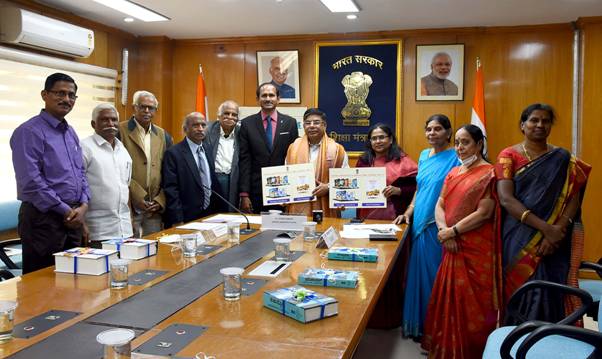
Hindi translation of Sangam text Tolkappiyam released


Union Minister of State for Education, Dr. Subhas Sarkar has released the Hindi translation of Tolkāppiyam, a unique work on grammar and poetics. 

A part of the corpus of Sangam literature, Tolkappiyam is the most ancient extant Tamil grammar text and the oldest extant long work of Tamil literature.

Tolkappiyam was written by Tolkappiyar during the Sangam period. According to some Tamil tradition places Tolkappiyam in the mythical second Sangam (great literary assembly), variously in 1st millennium BCE or earlier.

Tamil writing systems dates back to 250 BCE and Tamil Sangam poetry contains 2381 poems in Tamil composed by 473 poets, some 102 anonymous. Most scholars suggest the historical Sangam literature era spanned from c. 300 BCE to 600 CE to be among the finest of world literature.

Though it is reasonable to believe that the ancient Tamil itself had a long poetic tradition and a large body of literature, only a grammatical treatise in verse called Tolkāppiyam, the eight anthologies (Ettuttokai) and Ten Songs (Pattuppattu) have survived the ravages of time.

Ettuttokai consists of Nattrinai, Kuruntokai, Aignkurunuru, Pathittrupattu, Paripādal, Kalittokai, Akananuru and Purananuru.

A unique work on grammar and poetics, Tolkappiyam deals with Ezhuttu (letter), Col (word) and Porul (subject matter).

Almost all levels of the human language from the spoken to the most poetic lie within the purview of Tolkappiyar’s analysis as he treats in exquisitely poetic and epigrammatic statements on phonology, morphology, syntax, rhetoric, prosody and poetics.


Comments

  1. A book published in 1933 in Kolkata on ancient Indian Civilisation
    Available for free download.Download PDF book on rich Indian Civilisation from description link of this video
    ​https://www.youtube.com/watch?v=rs30ABDxu_c​​

    ReplyDelete

Post a Comment

Popular posts from this blog

Matangini Hazra

Matangini Hazra was a woman revolutionary and brave freedom fighter who fought for the independence of India from the British and laid down her life for it.  She was from a small village called Hogla located near Tamluk, the headquarters of the Purba Medinipur district in West Bengal. Hazra was born on October 19, 1870. Matangini Hazra was one of the protagonists of the Tamralipta Jatiya Sarkar (Tamralipta National Government), a parallel government established during the Quit India Movement.  Matangini Hazra was shot dead by the police in front of the Tamluk Police Station on 29 September 1942.  Matangini Hazra was  affectionately known as Gandhi buri, Bengali for old lady Gandhi.  The famed Hazra Road in Kolkata is also named after her. 

Muhammad Shah Rangila

Aurangzeb, the last great Mughal emperor, died in 1707. Muhammad Shah became Mughal emperor in 1719. During the interregnum, Bahadur Shah I , Jahandar Shah, Farrukhsiyar, Rafi-ud-Darajat and Rafi-ud-Daula ascended the Mughal throne. Jahandar Shah was murdered on the orders of Farrukhsiyar who had the support of the two powerful Mughal nobles Sayyid Abdullah and his brother Sayyid Husain Ali at that time. They are famous in history as Sayyid brothers, the King-makers. In 1719, Farrukhsiyar were murdered in utter disregard of a Mughal emperor by Sayyid brothers. Rafi-ud-Darajat died of consumption in a few months. Rafi-ud-Daula was addicted to opium and died in 4 months. Sayyid brothers now chose Raushan Akhtar, a son of Jahan Shah (the fourth son of Bahadur Shah I), to be the emperor. Raushan Akhtar ascended the throne under the title of Muhamamd Shah in September 1719. In the beginning Muhammad Shah was a puppet in the hands of Sayyid brothers who soon began to lose their gri...

Minhaj-us-Siraj: Author of Tabaqat-i-Nasiri

Minhaj-ud-din Abu Uraar bin Siraj-ud-din al-Juzjani, popularly known as Minhaj-us-Siraj,  was a medieval historian who was patronized by Slave Sultan Nasir-ud-din Mahmud to whom he had dedicated his magnum opus Tabaqat-i-Nasiri . Since Siraj held the high office of the Chief Qazi of Delhi to which he was appointed by Nasir-ud-din Mahmud, it is natural that Tabaqat-i-Nasiri gives a first hand account of the historical events from the conquest of Delhi by Muhammad of Ghur up to the year 1260 AD. Siraj was temporarily removed from the post of Chief Qazi from 1253 to 1255 when a section of nobles induced the Sultan to send his prime minister Balban into exile.  Tabaqat-i-Nasiri has been translated into English by Raverty .   -------------------------------------------------------------------------------------------------------------------------------- This page was last edited on 24 July 2021