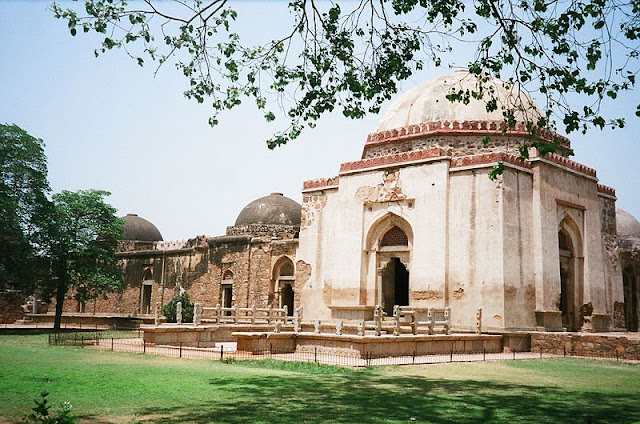
Firoz Tughlaq, the last prominent ruler of the Tughlaq dynasty

                            Firuz Shah Tughlaq's tomb in Delhi / Image credit

Firuz Shah Tughlaq (1309 – 1388 CE) was the third ruler of the Tughlaq dynasty of the famed Delhi Sultanate. He succeeded to the throne in 1351 after the demise of his cousin Muhammad-bin-Tughlaq who had become second Tughlaq sultan in 1325 AD. During his rule of 37 years, Firuz tried to bring a semblance of prosperity to his empire which had fallen into confusion and chaos during the rule of his predecessor due to the latter’s eccentric policies.

The early six years of his reign are documented in the Tarikh-i-Firuz Shahi, a contemporary account by medieval historian Ziauddin Barani. Another contemporary chronicle, also known as Tarikh-i-Firuz Shahi, written by Shams Siraj Afif, gives a detailed account of his reign.

He is credited with the founding of the cities of Jaunpur in 1359 (Uttar Pradesh), Hissar and Fatehabad (Haryana), Firozpur (Punjab). Jaunpur was named after Muhammad bin Tughluq who was known by the name of Juna Khan before his accession to the throne. Firozabad, the fifth city of Delhi, was also built by Feroz Shah Tughlaq. However, only the fortress and its crumbling remains in the forms of Jama Masjid (Friday mosque), a baoli (step-well), and a palace topped by a polished sandstone Ashoka Pillar brought by the Sultan from Ambala are found.

When the forth storey of Qutab Minar in Delhi was struck by lightning in 1370, Firoz replaced it with two more storeys, 

Firuz Shah Tughlaq was a religious bigot and this prevented him from being just to his non–Muslim subjects by imposing Jizya tax on them. 

He had prohibited Muslim women from worshipping the graves of saints. 

He is known to have as many as 180,000 slaves. According to Shams Siraj Afif, their rise brought disaster to the Tughlaqs. They annihilated Firuz's sons and played roles in destroying the Tughlaq dynasty. Firuz's eunuch named Malik Sarwar founded the  Sharqi dynasty of Jaunpur.   

Firuz died in 1388, aged eighty-two. 


Comments

Popular posts from this blog

Matangini Hazra

Matangini Hazra was a woman revolutionary and brave freedom fighter who fought for the independence of India from the British and laid down her life for it.  She was from a small village called Hogla located near Tamluk, the headquarters of the Purba Medinipur district in West Bengal. Hazra was born on October 19, 1870. Matangini Hazra was one of the protagonists of the Tamralipta Jatiya Sarkar (Tamralipta National Government), a parallel government established during the Quit India Movement.  Matangini Hazra was shot dead by the police in front of the Tamluk Police Station on 29 September 1942.  Matangini Hazra was  affectionately known as Gandhi buri, Bengali for old lady Gandhi.  The famed Hazra Road in Kolkata is also named after her. 

Muhammad Shah Rangila

Aurangzeb, the last great Mughal emperor, died in 1707. Muhammad Shah became Mughal emperor in 1719. During the interregnum, Bahadur Shah I , Jahandar Shah, Farrukhsiyar, Rafi-ud-Darajat and Rafi-ud-Daula ascended the Mughal throne. Jahandar Shah was murdered on the orders of Farrukhsiyar who had the support of the two powerful Mughal nobles Sayyid Abdullah and his brother Sayyid Husain Ali at that time. They are famous in history as Sayyid brothers, the King-makers. In 1719, Farrukhsiyar were murdered in utter disregard of a Mughal emperor by Sayyid brothers. Rafi-ud-Darajat died of consumption in a few months. Rafi-ud-Daula was addicted to opium and died in 4 months. Sayyid brothers now chose Raushan Akhtar, a son of Jahan Shah (the fourth son of Bahadur Shah I), to be the emperor. Raushan Akhtar ascended the throne under the title of Muhamamd Shah in September 1719. In the beginning Muhammad Shah was a puppet in the hands of Sayyid brothers who soon began to lose their gri...

Minhaj-us-Siraj: Author of Tabaqat-i-Nasiri

Minhaj-ud-din Abu Uraar bin Siraj-ud-din al-Juzjani, popularly known as Minhaj-us-Siraj,  was a medieval historian who was patronized by Slave Sultan Nasir-ud-din Mahmud to whom he had dedicated his magnum opus Tabaqat-i-Nasiri . Since Siraj held the high office of the Chief Qazi of Delhi to which he was appointed by Nasir-ud-din Mahmud, it is natural that Tabaqat-i-Nasiri gives a first hand account of the historical events from the conquest of Delhi by Muhammad of Ghur up to the year 1260 AD. Siraj was temporarily removed from the post of Chief Qazi from 1253 to 1255 when a section of nobles induced the Sultan to send his prime minister Balban into exile.  Tabaqat-i-Nasiri has been translated into English by Raverty .   -------------------------------------------------------------------------------------------------------------------------------- This page was last edited on 24 July 2021