As was only
to be hoped that being a British colony India was slowly gearing to the
adoption of English as the national language during the pre-Independent era.
Even after the attainment of freedom by India in 1947, Hindi has having a tough
time in achieving its due place in the country. Against this backdrop, Purushottam
Das Tandon, also known as Rajarshi, is remembered for his yeomen’s service in the
achievement by Hindi its due place as the National Language.
Sometimes his enthusiasm for Hindi was resented by some who accused him being communal and chauvinistic. It was by his efforts that Hindi began to be written in Devanagari script.
One of the foremost
leaders during India’s struggle for independence, Purushottam Das Tandon was also
a journalist, orator and social worker. He was born on 2nd August,
1882, at Allahabad in Uttar Pradesh. After receiving his primary education in
the local City Anglo Vernacular School, he got a degree in law and started practising
in the Allhabad High court.
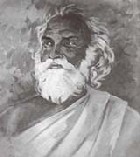
+Purushottam+Das+Tandon.jpg) |
| (Source: The Times Of India Group) |
During his student
days he joined Indian National congress in 1899. After being expelled from
Mayor Central College of the Allahabad University for his revolutionary activities,
he completed his studies in 1903 from a different college in Allahabad. He was
one of the members of Congress Party Committee formed to look into the Jallianwala
Bagh massacre. Responding to the call of Mahatma Gandhi, he joined the freedom
struggle by giving up his law practice in 1921.
In 1946, Purushottam
Das Tandon was elected to the Constituent Assembly that drafted the Indian constitution.
He served as the Speaker of the Legislative Assembly of Uttar Pradesh and remained
in the post for thirteen years.
Though Tandon contested unsuccessfully against Pattabhi Sitaramayya for the position of the President
of Congress in 1948 but was able to defeat Jivatram Bhagwandas Kripalani popularly
known as Acharya Kriplani, in 1950 to be the president of Nagpur session. Jawaharlal
Nehru was opposed to the candidacy of Tandon and he even threatened to resign. During
his tenure there was a lack of co-ordination between the party and the
government. Since then it has been the norm in the Congress party to have the
same person as the president and head of the government or at least a pliable
candidate for the post of either of the two. Purushottam Das Tandon won the Lok
Sabha poll in 1952 and went to the Rajya Sabha in 1956.
On 23rd April,
1961, Purushottam Das Tandon was awarded Bharat Ratna, India’s highest civilian
award. He breathed his last on 1st July 1962.
hi;;
ReplyDeletejust writing to say thank you;;;
I am preparing for civil services and your site is very helpful;;;
you should state the reference of your post in every post;;
it will be much better for each of us..
jitendra
jitendra-gupta.blogspot.com
Thanks Jitendra. Henceforth I will try to include the references.
ReplyDelete